6-Cylinder Air-Pressure Engine
When I started this work-shop adventure a few years ago, I asked my son John “Where do I begin?” He said if I go take a metal-shop class, besides the theory and safety classroom instruction, I’ll do a project like a little steam-engine. So I went down to the local community college, and the only classes they had like I was interested in didn’t start for several months, so I just bought all the text books. Then I went online, and Googled around to see what else I could find. What I found was a bunch of designs for trivial little 1-cylinder air-pressure engines for classes all over the country. But I said to myself, Dang! I can do better than that!
I decided to design a training project myself. I figured I needed to sharpen up on my CAD skills too, so I started laying out an idea, and one thing led to another, and I ended up with a 6-cylinder radial engine. At first, (of course) I designed an utterly unbuildable contraption, but John and I refined it down to a little more manageable design. I was reminded of a concept I heard a lot about in my previous employment, called “Design For Manufacturability”. I guess they have a similar problem in the industry, where some bone-head engineer designs some crap that causes the manufacturing guys just roll their eyes and curse the new-hire syndrome.
What I ended up with is a little beauty with 1-inch pistons, and a fairly simple layout. All together it consists of 65 parts and 105 screws. The whole engine and most of the parts are WAY more complicated than they ought to be for a first-time project, but if figured, “What the heck, I’m doing it for fun anyway!”
So I’ve been working on it for a while now, and it has been successful so far in that I have learned a TON of information and skills.
Several of the parts turned out really poor, so I set them aside and made better ones. One of the lessons I’ve learned is that you can’t make precision operations using non-precision machinery. So I put this project on hold and installed the DRO. That made a HUGE difference in the quality of parts I can produce now, so I’m back on track. One of the other lessons I’ve learned is that working without a schedule or a budget is great for the relief of the hassle, but nothing ever gets completed and the expenses just keep climbing. I gotta figure out how to balance the desires and the reality.
The parts are made from aluminum and steel – the main shafts, bushings, and pins are steel, and everything else is aluminum.
· The flywheel consists of 6 sections bolted together.
· The main shaft front and rear are disconnected, and are synchronized by the connecting rod pins.
· All 6 connecting rod pins are oriented in the crankshaft by one of the connecting rods.
· As the timing plate rotates it exposes air holes to the top of the cylinders in turn to either the air pressure or the exhaust vent.
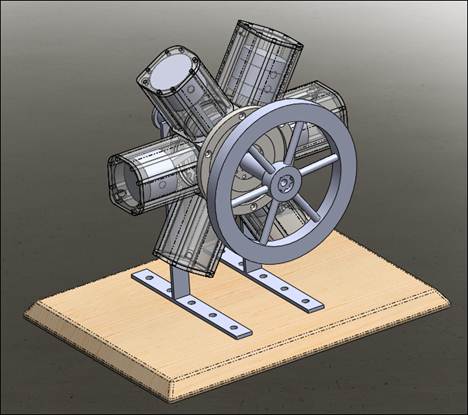
This image is made with the cylinders rendered in acrylic, and no fasteners showing.